Saturday, July 13, 2019

My Quest To Save Monarch Butterflies, Part 6

The stripes are becoming visible on this very young caterpillar but the colors aren't distinct yet.

Spunky is a day older and thus his stripes stand out clearly.

Yellow, black and white hues have Hitch Hiker looking cute as can be. He got his name by getting a ride as an egg to the screenporch on a leaf I intended to feed bigger caterpillars. Thankfully, I noticed the egg and secluded it.
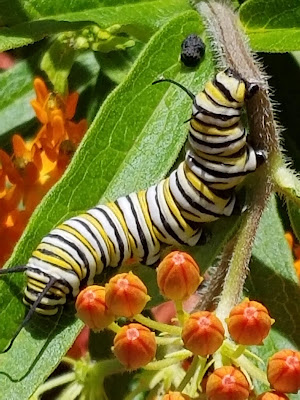
Wouldn't it be glorious to be nestled among these beautiful buds?


I bet that bud is tender and sweet.


Caterpillars go through 5 growing stages called instars. They outgrow and shed their face caps and skin when they advance to the next stage. This "cat" is about to lose its face cap.

In my next post, I'll share photos of more caterpillars as they mature.

My Quest To Save Monarch Butterflies, Part 5


After leaving its egg and wandering for a bit,  a newborn caterpillar returns to the egg and consumes it, gaining valuable nutrients in its first meal.

This "cat" has learned that milkweed leaves are good food too.


They are extremely small at first. Do you see it at the lower right? Yes, I named my "pets" to help me keep track of them and for the fun of it.

...empty egg and newly hatched "butterfly to be" baby...

Do you see the tiny black dot to the left of the leaf? That's the head of this newborn. The body is barely visible against the white paper towel.  I kept busy returning wandering babies to their milkweed leaves.

The regular size paperclip proves how tiny this baby is.

My next post will show you the growing caterpillars as they progress through maturing stages.

Thursday, July 11, 2019

My Quest to Save Monarch Butterflies, Part 4


After much editing of my original video, I finally have this short version to share with you.

This tiny caterpillar, only 1/8th inch long, has just emerged from its shell. It is nearly colorless and transparent as it explores its new environment. The black, white and yellow stripes will appear as it matures.

In my next post, I'm looking forward to sharing photos of the next few minutes of this caterpillar's journey.

My Quest to Save Monarch Butterflies, Part 3


A monarch butterfly laid this egg on the underside of a milkweed leaf.  I adopted it and placed it in a covered container. Several times a day, I would check on it.

Notice the ribbing on the egg shell. The ribs develop as the egg matures. (They wouldn't be visible without the zoom feature on my camera).

This egg will soon hatch. The dark spot is the head of the caterpillar.  An egg matures and hatches 3 to 6 days after it is laid. 


After raising several caterpillars and releasing them as butterflies, my next challenge was to look for eggs on the underside of the milkweed leaves and to attempt to nurture them to their intended destiny.  I'd read everything I could find on raising monarchs so I knew what I was looking for.

As the weather warms, monarch butterflies from Mexico and southern states make their way north. They are constantly in search of milkweed plants to lay their eggs on.  The population of monarchs is declining because milkweed has become scarce.  It has been removed from roadsides and many homeowners think of it as simply a weed and get rid of it.

A butterfly will flit from leaf to leaf, depositing one egg at a time. It didn't take me long to locate the tiny white eggs I was looking for. Fortunately, the white color is fairly easy to spot against the green of the milkweed leaves. Unfortunately, locating the eggs on the underside of the leaves is challenging as it involves a lot of stooping and neck twisting.

Initially, I picked a leaf with its egg from a plant and brought it to the screen porch.  I put the leaf and egg in a covered container on a piece of paper towel. I checked frequently on the egg. I didn't know how mature it was so I wasn't sure when it would hatch. It takes 3 to 6 days for an egg to mature and the tiny caterpillar to emerge.

In my next post, I will show you a newly emerged caterpillar. They are so cute and consequently, so vulnerable.

Tuesday, July 9, 2019

My Quest to Save Monarch Butterflies, Part 2


I found my first caterpillar on July 7th, 2018. After relocating it from the milkweed plant it was feeding on to the safety of a mason jar on our screenporch, I brought it fresh milkweed frequently and cleaned the jar just as frequently. My "cat" was an eating machine and since what goes in, must come out, the jar regularly needed emptying.


4 days later, I found my "cat" hanging up-side-down from a white fuzzy button on its milkweed sprig. It was hanging in a distinct J shape.


The next day, a pale green chrysalis was hanging where the caterpillar had been.


After 10 to 14 days, the outer layer of the chrysalis became transparent and I could see the compacted wings of a monarch butterfly inside.


I ordered a mesh enclosure and placed the chrysalis inside. I wanted to be certain there was room for the butterfly to move around after it emerged from the chrysalis.  I didn't witness the emergence of my first butterfly but was thrilled to find it moving its wings as it hung at the bottom of the empty chrysalis.


That's it in a nutshell. I found myself under the spell brought on by witnessing this magical transformation.

I spent the rest of the summer gathering caterpillars and even the eggs they hatch from on my milkweed plants.

In further posts, I will go into greater detail about my experiences and I'll share some of the hundreds of photos I took.

Sunday, July 7, 2019

My Quest to Save Monarch Butterflies, Part 1

This is the first caterpillar that I adopted.

I brought it onto our screenporch and gave it a home in a Mason jar.


Probably 3 years ago, my husband and I bought 3 milkweed plants at a wildflower sale. They were slow growers, but last summer, they grew to a decent height. I had no intentions other than to enjoy the monarch butterflies they would draw to our yard.

Passing the plants one day in early July, 2018, I spotted a beautiful yellow, white and black striped caterpillar on a leaf. I recognized it was a monarch caterpillar and remembered as a child, witnessing the transformation of a "cat" to a butterfly in a jar on my mother's desk in the living room.

After being in awe for a few moments and with little thought, I brought the "cat" on a sprig of milkweed onto our screenporch. I admired it for a while and then panicked. I thought, what if it dies under my care. That would be awful. It's better off on the plant where it was minding its own business, living the life it was intended to live.

I returned it to where I found it and felt good about my actions. I returned to the screenporch alone. My curiosity prompted me to Google monarch butterflies. I quickly learned that only 1 in 10 monarch caterpillars survives to become a butterfly.

WELL! That fact had me scurrying back to my milkweed patch. Phew, the caterpillar was still there. Nothing had snatched it away. I looked to the right and then to the left, daring any predator to come near my precious "cat."

Thus, my quest to save monarch butterflies began. I nestled my caterpillar and a sprig of milkweed in a Mason jar with a square of cheesecloth on top, secured with a rubber band.

At that moment, saving one caterpillar was all I had in mind.

Saturday, July 6, 2019

Back in the Saddle Again

I've been away from my blog for 3 years. I'm here to see if I can still create a post. Let's see if I can post a photo.


Well, well, well. There's still hope for this old girl.

My sister in law, Jill, suggested I use my blog for sharing my experiences raising monarch butterflies. I spent July, August, and September last year taking in eggs and caterpillars from my milkweed plants, caring for them and finally, releasing them as butterflies.

I have many photos of the journey from egg to butterfly.

I shared many of my photos and experiences on Facebook and had many followers who enjoyed my posts.

So let's see where I go.